The Johnson Memorial Health Services (JMHS) Board of Directors has completed the National Rural Health Association’s Rural Hospital Board Certification Program, becoming the pilot group to earn the certification through a board-wide learning model.
The certification program, administered by the Center for Rural Health Leadership, is typically completed by individual rural hospital board members. As the pilot organization for the group model, JMHS brought its entire board through the program together, creating opportunities for members to learn, discuss, and apply rural healthcare governance best practices as a unified leadership team.
“This is a significant accomplishment for our board and for JMHS,” said Jake Redepenning, JMHS Chief Executive Officer. “Our board members invested considerable time and energy into this program because they understand how important strong governance is to the future of rural healthcare. Being selected as the pilot group made the experience even more meaningful. It allowed us to learn together and immediately apply what we learned to the decisions we make on behalf of JMHS and the communities we serve.”
Board members completing the certification were Sue Johnson, Ken Perkins, Todd Bach, Dean Lehmann, Musarrat Virji, Sandie Club, Mark Thompson, Jay Kleven, and former board member Reid Jurgenson.
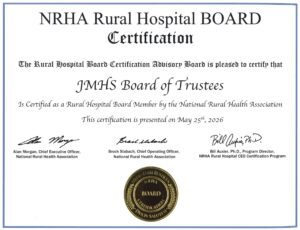
The board began the program in November 2025 and completed a seven-month curriculum consisting of 13 core modules. The program combined independent study, facilitated virtual discussions, an in-person board retreat, online assessments, and the development of best practices for JMHS board meetings.
Topics included new board member orientation, the elements of board membership, governance versus operations, healthcare finance, community health, strategic planning, quality and patient safety, advocacy and community collaboration, the board’s relationship with the CEO and organizational leadership, benchmarking, medical staff oversight, philanthropy, and board self-evaluation.
“This program gave us a chance to strengthen our knowledge, evaluate how we govern, and identify ways we can continue improving. Completing it together helped ensure that we have a shared understanding of our responsibilities and the challenges facing rural healthcare,” said Board Chair Sue Johnson.
For Sandie Club, one of the board’s newer members, completing the certification provided a valuable foundation for serving in a rural healthcare governance role.
“Joining a healthcare board comes with a great deal of responsibility, and there is a lot to learn,” Club said. “The program helped me better understand the board’s role and how the decisions we make affect our patients, employees, and communities. Going through the program alongside the other board members also gave me the opportunity to learn from their experience.”
Dr. Bill Auxier, program director for the NRHA Rural Hospital Board Certification Program, praised the JMHS board’s participation in the pilot program.
“Alan Morgan, CEO of NRHA, has said time and again that leadership is the biggest predictor of a rural hospital’s success, and I fully agree with that statement,” Auxier said. “Leadership starts at the top of the organization, which means it starts with the hospital board. It was an honor to work with the JMHS board during this pilot program. It was a delight to see their eagerness to learn, their engagement with one another, their dedication to their community, and their commitment to excellence in board governance.”
Redepenning said the certification reflects the board’s broader commitment to responsible stewardship and continuous improvement.
“JMHS is fortunate to have board members who are committed to this organization and the people we serve,” Redepenning said. “They are volunteers who give generously of their time, bring thoughtful perspectives to difficult decisions, and remain focused on ensuring that high-quality healthcare continues to be available locally. Their commitment to continued learning and strong governance directly supports our mission of “To Provide High-Quality, Compassionate Healthcare, Close to Home.”We are proud to recognize each of them for earning this certification and for helping establish a model that may benefit other rural healthcare boards.”